
Designing your AI pipeline
Organisations are drowning in AI ideas and starving for alignment.
Models have collapsed the cost of generating options, so the real cost now sits in deciding which ideas deserve data, money and attention. The operating model is now the real constraint.
We recently delivered an AI acceleration sprint built for that constraint. It compresses months of scattered conversation into a single day of disciplined decision making, treats AI as an operating model problem rather than a tools problem, and gives people a practical sense of what an AI ready organisation feels like. AI simply makes the funnel wider. Every function can now produce a convincing list of possibilities, all plausible and all competing for the same scarce capacity in your AI pipeline.
Our piece on stopping the AI pilot spiral explains what happens when organisations try to scale that noise. Pilots multiply. Value fragments. The operating model stays the same. The pipeline clogs, then stalls.
From funnel to operating model
Most of the noise in the market right now is agencies selling prompts, vendors selling tools, consultancies selling theatre and contractors selling rebranded headcount. They are all selling fuel. If you pour rocket fuel into a steam engine you do not get a rocket, you get an explosion. What is missing is the architecture that shapes the AI pipeline and the operating model it runs through.
Whether AI creates value or chaos is not about which model you choose or which co pilot you deploy. It is about how your organisation is wired: the human systems, technical systems, decision loops, accountability, rhythm, governance and flow that determine what moves through the pipeline and what never makes it past a slide.
You do not compete with hype. You compete with gravity. AI will not scale without an operating model that is adaptive, agentic, governed and wired for more autonomous work from idea intake through to production.
Underneath that operating model is something more uncomfortable: people and culture. Most organisations are still running on a default culture that was never designed for thousands of powerful ideas appearing everywhere, all at once. People are getting access to models. What they are not getting are the techniques and judgment to decide what deserves to enter the pipeline, and what should never leave the whiteboard.
When ideas are free, decisions become expensive.
The integration zone
This is where AI implementations fail. They do not fail in the code. They fail in the cross over zone between strategy and execution, where the AI pipeline should connect to the rest of the business. This is the zone of unclear decision rights, legacy workflows, misaligned incentives, invisible risk and messy systems of systems. No software vendor fixes this, because they want to sell you licences. No traditional consultancy fixes this, because they want to sell you hours. This is the neutral layer above vendors, platforms and consultancies, where you are not choosing tools, you are designing the conditions for an AI pipeline that can actually be trusted.
Most organisations are facing one of two scenarios. Either they have lots of ideas but no pipeline and no execution strategy. Or they are running disconnected pilots that do not align with business goals and never quite join the operating model.
We recently ran a LinkedIn livestream unpacking this integration work with a client. They did not need more ideas; they needed a way to capture, rank and rapidly prototype the ideas they already had so a real AI pipeline could start to form.
Using a big room format, we gave everyone one place, one language and one set of constraints, then used simple agents to turn conversation into a prioritised portfolio.
If you want to see what that looks like in practice, watch the recording of that discussion.
Case Study: Barwon Water’s AI Design Day
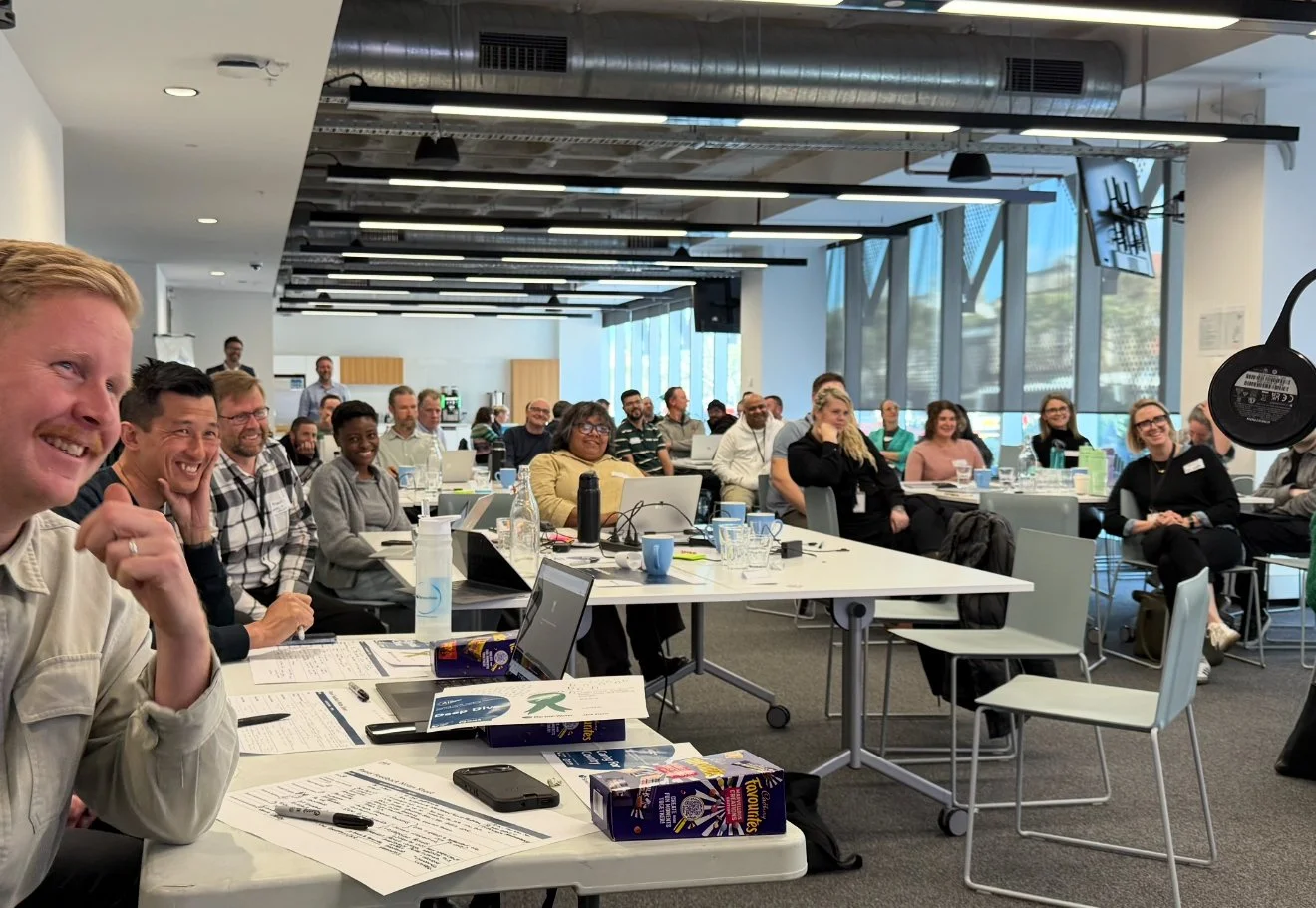
Barwon Water, Victoria’s largest regional urban water utility, faces a reality: the customer base is set to double by 2050, but headcount cannot. AI was already on the agenda, but ideas were scattered, pilots were isolated, and there was no shared view of what to do first. We convened a one day AI pipeline accelerator event, bringing 65 staff and 9 Deakin University students into a single room.
In the lead up, we curated existing AI ideas into a single pipeline. On the day, two custom built agents were used to capture, standardise and size that pipeline. They turned a seed list of about 30 ideas into more than 100 structured AI use cases detailing the problem, value and strategic fit, then estimating complexity from data needs, integration effort and change impact. We used tools to accelerate the hardest part of AI work, Alignment. Tools handled the bureaucracy of alignment, field teams and executives the trade offs.
Mixed teams from different parts of the business used these use case cards as their starting point. Students then vibe coded simple prototypes, turning concepts into stories to present to an executive panel for feedback. By close, Barwon Water had: 8 priority AI starters with named owners, a clear split between near term uplift and longer horizon bets and 31 volunteer champions and a noticeable lift in confidence.
Most importantly, AI moved from hype to a visible, owned pipeline of work. One day did not fix culture or architecture. But it did change the trajectory of Barwon Water’s AI pipeline by forcing trade offs into the open, with the people who would have to live with them.
“It’s not just a digital technology problem. We are surfacing a lot of inherent business challenges we have to address as a result of this drive towards using AI.””
The 2 track approach
Both speeds matter. Both fail if they run only on legacy rails and legacy behaviours.
One operating model does not mean one system or one vendor. It means one coherent way of organising people, data, decisions and platforms so work can run at different speeds without tearing the organisation in two, and so the AI pipeline always has a clear path from idea to impact.
For CIOs and architects this is the work: deciding which ideas sit in a disruptive lane and which belong in capability uplift, then wiring funding, governance, data and platforms so those lanes can run side by side. Disruption explores new AI enabled products and services at the edge. Uplift hardens proven patterns into the core.
Done well, data moves safely across the estate, reuse is rewarded and people are clear whether they are running an experiment or shipping a standard. That is how the AI operating model turns noise into a portfolio you can actually steer.
Your organisation is the product
An AI focused design sprint does not solve AI. It proves that your organisation can choose to solve it.
It gives you a shared language, a live AI pipeline, clear owners and real dates. It leaves you with a sober view of the AI operating model and culture you will actually need.
AI will not reward the organisations with the best prompts. It will reward the organisations that can make decisions at pace, govern risk without suffocation and move from idea to impact without getting lost in the noise.
At FromHereOn, we help CIOs and architecture leaders design and run the AI operating model their business needs, from disruptive new services to safe capability uplift on today’s platforms.
Whether you need to re architect the operating model to match the speed of market change, or run a Design Day to turn the wheel on your first pilot, we can help you cut through the noise and move from pilots to production.