
Water corporations across Australia and New Zealand are heading into price reviews with the same brief. Serve customers better, protect the environment, keep bills affordable and show the regulator the evidence. Most will find they have more to fund than they can afford.
Showing each investment is prudent is the familiar half of the task. The harder half is showing the organisation can deliver the plan. That burden of proof now sits with the business itself.
It lands at an awkward moment. Tier-one contractors are stretched, specialist skills are scarce, and the people who know the systems best are already at capacity. AI has joined the list of things everyone wants to fund.
Water is user-pays, so the stakes are direct. A programme that is funded and then stalls still lands on customers' bills.
Watch the replay
Pam Grundel, Head of Digital Business Transformation at Barwon Water, joined [David White and Justin Callaghan] to talk about how Barwon plans its investments.
Pam explained why Barwon's first attempts at capability mapping fell short, what changed and what the team has learnt since. She showed how an agreed map and current enterprise data made investment decisions easier to defend.
Capability-led planning
A capability map answers one basic, high-stakes question: can we actually deliver what we are about to fund? It puts what the organisation must be able to do on one page, and shows where it is struggling and what has to improve. Choices then rest on evidence instead of assumptions, one person's knowledge or the loudest voice.
A starting point for investment conversations.
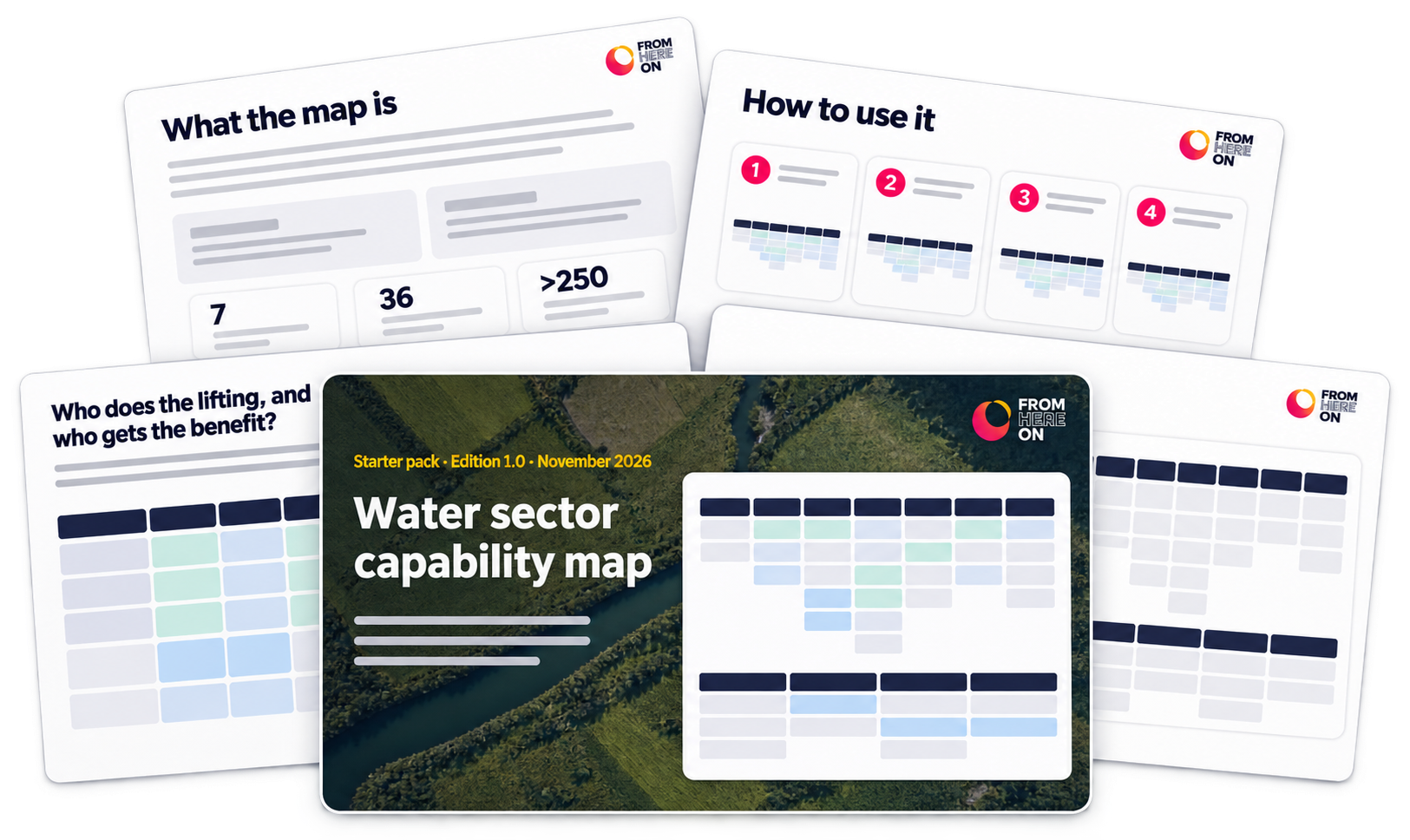
Download the water sector capability map.
What's possible for the sector?
Every water corporation is answering the same question, and most are answering it alone. They don't have to wait for sector-wide agreement to change that. A few corporations using the same map can show a practical approach others can learn from: a common language for comparing where capacity is thin, sharing what worked and making the case to regulators. The map won't make the decisions or guarantee the outcome. It gives leaders a better conversation, and customers a better chance that what they pay for gets delivered.
Where to start?
You don't need 2 years. Our starter water sector capability map, built with Barwon Water and other water corporations, follows the asset lifecycle from plan to dispose.
Download the map. Mark what your business must be good at.
Place one investment on it. Try a smart meter rollout. Customer service is obvious. Asset records and old-meter disposal are what plans miss.
Fix the gaps first. Fix the stretched capabilities before you commit the budget.
Every water corporation has more to fund than it can afford.
Use the map with your team to see what each investment relies on and where projects compete for the same capabilities. Tell us how you go.
Not sure you can deliver your priorities? Let's talk.