
Operating Model Design - First Principles
“Today’s managers are trying to implement third-generation strategies through second-generation organizations with first-generation management.”
Customer expectations are not just changing; they are exceeding the ability of a business to deliver on time. Consumers are looking for alternatives, with more emphasis on experience and convenience. To keep up, companies are evolving their offering to meet the changing needs of the market. The ability to deliver cutting-edge services to market is largely determined by your operating model. When your services evolve, corresponding changes need to be reflected in your operating model. Trouble is – many of us wouldn’t know what our business operating model is – let alone what it needs to be.
The term 'Target Operating Model' (TOM) means different things to different people. When trying to define a TOM, there are common themes that emerge in the various canvases, models and frameworks. ie. The Organisational structure, Resources (people, processes, information and technologies or ‘tools’), Services, Suppliers, Locations, Governance, Sourcing etc. Some of these items might also form part of your business model, business capability model or even customer journey map. This raises a few questions; 'What is an Operating Model?', 'How would you use one to operate a business?', and 'What are the necessary components to consider?"
Taking a step back, I think it's helpful to ask 'what do we need to successfully ‘operate’ anything in general?' And what does this mean when we consider operating a 21st-century business?
In this article, I will outline and provide insights into how we define and use operating models at FromHereOn. When used effectively, this approach can equip you (the ‘business operator’) with the levers and tools necessary to ‘drive’ your business.
Operating a system
To successfully operate or run any system of things, we need the following:
An understanding of what the system is and it’s intended purpose – the goals of the system
An understanding of the desired behaviour – what ‘good’ operations look like
An understanding of the ‘levers’ and controls – which levers are available, what they do when applied, and under what circumstance they should be applied – the controls and ‘rules’ of operation
Timely performance feedback to tell you when to change or apply controls to maintain ‘good’ operations
There are many operating ‘levers’ available to a business operator to influence their business. They range from; the structure of the business, processes, deployment of resources, timing of activity and more. It's important to consider the scope of influence in this role and the importance of strategic alignment. A business operator might not own the business goals but they certainly need to understand progress made towards achieving them. Similarly, the business operator may not be responsible to design company services, but they need to ensure that services and products are delivered as and when intended.
Another important aspect is scale. The concept of operating model is as applicable at a team, department or line of business level as it is at a whole of business scale.
So, what is operating model design?
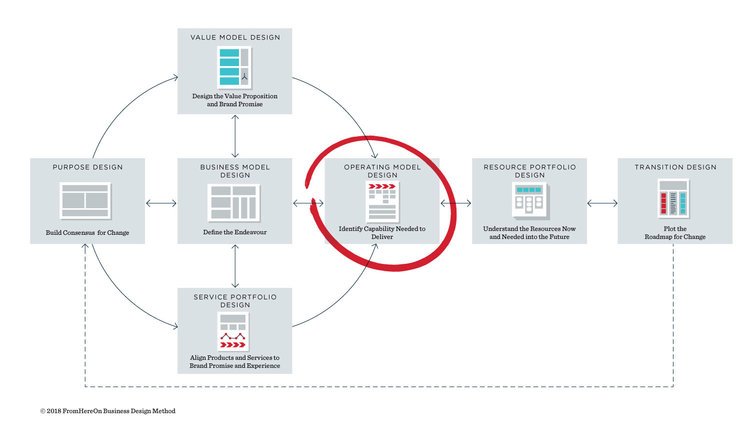
Operating Model Design is the fifth design process in the FromHereOn Business Design Method, a method designed to align strategic thinking across the business. Other design activities address purpose, customer, value proposition, services and business model.
Operating Model Design takes an inside-out perspective on the business. The customer need provides context, but it adopts a capability-based approach.
At the heart of the operational design challenge is the question: 'how might we best organise and manage our resources to effectively operate our business, deliver services as intended, and meet our goals?
The Operating Model Design process hinges on an understanding of business capability. Business capabilities represent the natural groupings of people, process information and technology resources that enable an organisation with the ‘abilities’ required to deliver services and achieve goals.
Understanding WHAT capabilities (i.e. combinations of people, process, information and technology resources) are needed is one aspect. Understanding HOW to best deploy and manage them is another. HOW is the focus of Operating Model Design.
-
Developing a Business Capability Model is a foundational input necessary for an Operating Model. A Business Capability Model acts as a company-specific reference model.
The Capability Model can be used to indicate capabilities that are:
Essential for the delivery of services
Of strategic importance to achieve a particular objective
In-house or outsourced to a third-party (i.e., Supplier or Business Partner supplied capability).
High or low level maturity
The focus of operational pain points
It is important to remember that a Business Capability Model includes all capabilities. From those that interface with customers to the back-office capabilities that enable those interactions.
-
This component is essentially a ‘map of operations’. It typically describes the location and/or configuration of all resources and capabilities in a business. The locations within this model might be logical (e.g., types of facilities) or physical (i.e., actual physical address). In its simplest form, the Deployment Model describes which business capabilities are available per location or location type.
-
The processes within each of the capabilities in the Business Capability Model will react to, or initiate events. Understanding what the necessary business cycles are, and the key events within them is critical to understanding how to operate a business. Any business will follow monthly, annual and multi-year business operating and planning cycles (e.g. Financial year cycle, Employee Performance Review cycle etc.). The Operations Calendar component forecasts and schedules these events to better understand and anticipate capability impact. For example, your financial year reporting cycle should correlate with your business planning cycle?
-
Operating any system requires timely feedback. The timeliness of performance feedback will have a direct impact on the ease and success of operations. Performance reporting will be one of the cycles scheduled in the Operations Calendar. This allows you to assess key metrics using a set of performance indicators. The performance framework typically includes measures on:
Progress against strategic objectives
Customer experience and satisfaction
People performance
Process performance
Asset lifecycle
Financial performance
-
This component is a functional view of the business. It includes the infamous Org Chart, often misunderstood as the actual Operating Model. This component maps the governance responsibilities and accountabilities to the roles within an organisation.
“Physical structure is crucial in a system, but is rarely a leverage point, because changing it is rarely quick or simple. The leverage point is proper design in the first place” – Donella Meadows – Thinking in Systems 2008.
The underlying Business Capability Model can be used to identify the resource sets that need to be managed. It is also used to map roles to capabilities. Identifying cross-cutting capabilities (i.e. capabilities that coordinate other capabilities like demand management) is helpful for identifying second-tier management roles. This is a key structural decision that will act to either reinforce or discourage functional silos within a business.
Contemporary businesses are often characterised by flatter management structures. They operate with distributed work environments across different time zones and jurisdictions. This requires enough local accountability and responsibility to promote operational flexibility, ‘self-organisation’ and responsiveness.
-
The governance component of an Operating Model captures the business rules (e.g., policies), the responsibilities and decision-making structures or forums within an organisation and their jurisdiction. This component provides the rules by which the other components are managed and operated. It also interfaces with the Operating Calendar and business planning cycles by determining the scope and role of the various business plans (e.g. strategic plan, business plan, operations plan).
-
Brand Identity is like the ‘personality’ of the business. Brand Characteristics and Values guide behaviour and ideally permeate every aspect of operations. All other components in the Operating Model need to be consistent with the brand identity of an organisation. As business operator, you should act and influence the system in alignment with the brand identity.
-
Last, but by no means least, is an understanding of the business’s service portfolio. Operational Design does not include the actual design of services, but it does require an understanding of existing services and the associated customer experience. The Operating Model that controls and manages the availability and delivery of services. It is also responsible to ensure service and customer experience continuity.
Operating Levers
Understanding the operating components is a necessary precursor to operating a business effectively. Contemporary business’s need to be alert to the environment in which they operate. How customer centric, responsive, collaborative, people focused, and data driven is your business?
Operating a business to achieve these characteristics requires;
access to performance information,
an appreciation of brand identity
an understanding of services and customer experience,
an understanding of available resources, where they are and, how to deploy.
It also requires a business designed to operate with minimal ‘intervention’. Flat organisational structures with clear accountability empower employees to be proactive. Autonomy fosters agility and ‘self-organisation’ creating efficiencies and headroom for innovation.
At FromHereOn we use a human-centric, co-design approach when defining Target Operating Models. The target state is determined by extrapolating the purpose and motivation of the business. It is also important to ground any transformation plans in context of existing capabilities.
Configuring each of these components to the requirements of your business isn't easy. A Target Operating Model is much more than an org chart, it is a more comprehensive system view that prescribes ways of creating value and delivering on your promise to customers. Employees need more than a conceptual operating model, they need to be engaged, empowered and inspired to provide outstanding services to both customers and colleagues. We feel this is key to designing a way of working that is woven into the cultural fabric of the business.
“Capita Government Services recognised the need to transform its operating model to increase customer focus and operational efficiency. We engaged Fromhereon to provide the independent facilitation that would give the members of the leadership team confidence to fully air both their ideas and concerns. The team supported the leadership team with a series of organisation design workshops which debated and conceived a new operating model for the business. 6 months later, that operating model has delivered dramatic improvements in customer intimacy and transformed the pipeline of opportunities for the business.”